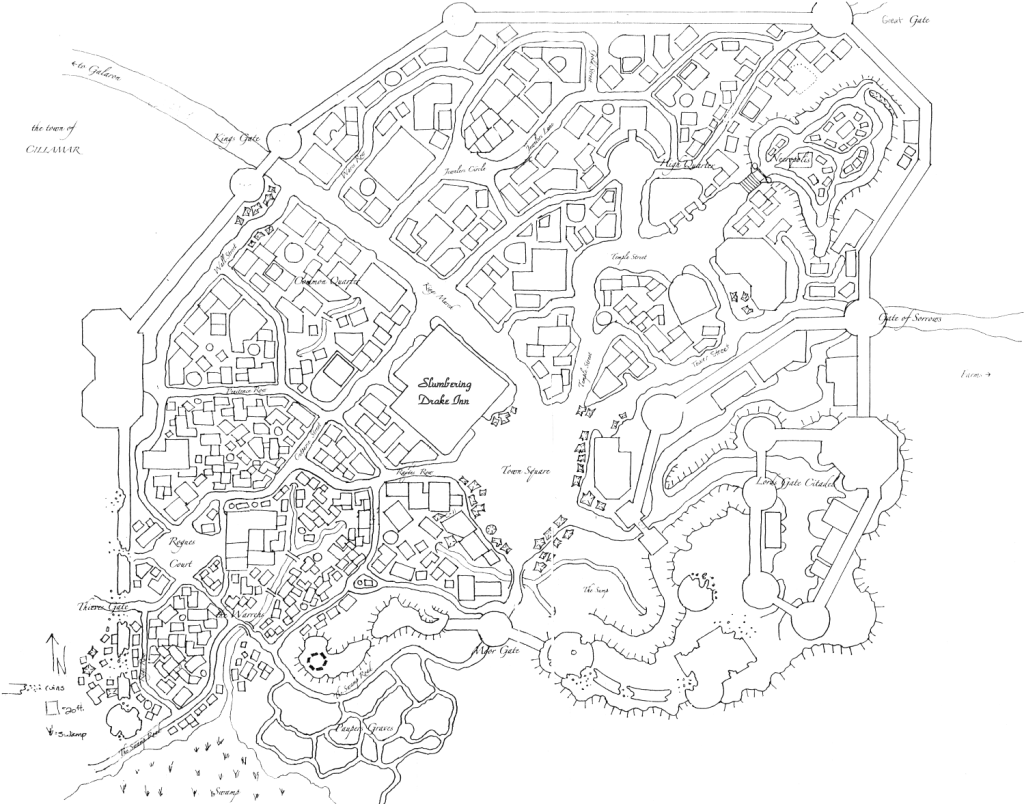
The anchor of civilization in the wilds of western Morrain, the town of Cillamar has long carried an importance belied by its small size, and the last two years have brought dramatic changes to the once sleepy town. The looming Ul Dominor peaks have always hidden mineral treasures, but the discovery of rich placer veins has brought a surge of new wealth and foreign treasure seekers, Add to this mix the influx of desperate refugees from the conflicts of the Warlands, and adventurers looking to make a quick fortune—the result is a Cillamar that none of its founders could have predicted: a chaotic, frontier boomtown, where the quick and courageous can become wealthy overnight, and where sharp knives and longswords solve disputes as frequently as the town watch. Cillamar’s busy streets are packed with foreign merchant-lords, hardened war veterans, stone masons rushing to meet the demand for new shops and homes, foreign princes and their companies of stern knights, and eager-eyed adventurers. The number of true “natives” remains around 1,000 souls, but the flood of traders and refugees has pressed the town’s population closer to 3,000, and even higher during the late spring, summer, and early fall.
The laws of Cillamar are enforced by the warriors of the Lantern Watch, known by the distinctive silver-painted lanterns they carry on poles during their night watches, and by the Magn’gard, the Patriarch’s personal company of elite soldiers. Those in the Lantern Watch gird themselves in studded leather and carry spears and crossbows, with officers wearing shirts of chain and fight with longsword and shield. The Magn’gard wear suits of chainmail and plate, and typically fight with bastard swords. The Magn’gard is augmented by the Anseur-lyth, a company of elven master archers serving at the pleasure of the fae Queen of the Anseur Forest. Finally, no analysis of Cillamar would be complete without relating the events that brought an awareness of the greater world to frontier settlement. Over the last few years, refugees from the Warland conflicts have flocked to Cillamar, driving down the price of manual labor and flooding the town’s slums. This influx also brought an increase in crime, as Cillamar’s poor have been forced into ever more desperate straits. The resultant tension has driven a wedge between Cillamar natives and the Warland refugees.